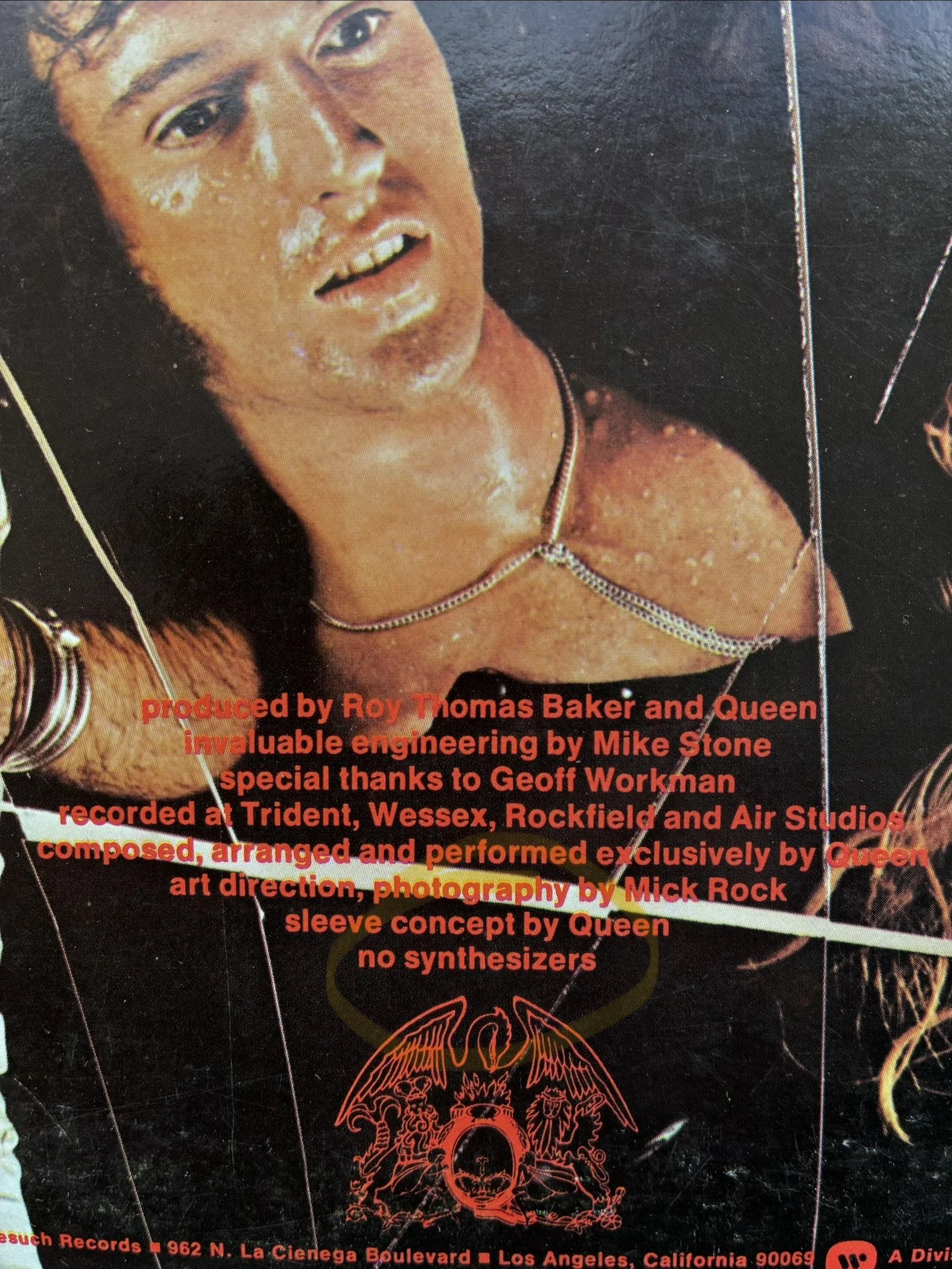
No Synthesisers!
The rear cover of Queens 1974 album, Sheer Heart Attack (above), proclaiming no use of synthesisers. Queen I and II and the subsequent albums A Night at the Opera and A Day at the Races, all staked the same claim.
To AI or not to AI?
Queens first five studio albums, from 1973’s Queen I, to A Day at the Races in 1976 (just mildly prolific), all proudly proclaimed that no synthesisers were used in the making of those records. As a keyboard/synth player, I took no offence to this, interpreting it as just a means of clarifying that their impressive sound palette was created using primarily guitars and human voices, at a time when synthesisers were becoming a key component of rock music and even crossing into other genres - Switched on Bach and Jean Michel Jarre’s Oxygene spring to mind.
Some might argue that the tape loops, filters, equalisers and other FX that were applied to Brian May’s guitars and the iconic Queen harmonies were a form of synthesis, but I for one was happy to accept their declaration in good faith.
In late 2025 I set about writing my first memoir. The process of writing can, at times, be difficult and laborious, and it occurred to me, fairly early on in the process, that there were very powerful AI tools at my disposal which could, potentially, streamline and expedite my writing. This assumes, of course, that I would be happy with the results and not need to go back and redo the work. But I took the fairly easy decision (for me at least) to avoid that temptation, tied to my firm belief that a memoir is a very personal outpouring of experiences, reflections and emotions. I hoped, of course, that my audience would recognise this in my language and place some value on that authenticity. One of the most enduring stories in my book is about my first major concert experience - Queen at the Hordern Pavilion, Sydney, in April 1976. I was immediately reminded of the bands ‘No Synthesisers’ claim, and saw the obvious parallels. Even 50 years ago, artists were keen to be acknowledged for the effort, talent and creativity that is sometimes required to not take the easy route, or the path of least resistance.
Proudly Human
By July 2026 I was in the later stages of proofing and editing my book. One Saturday morning I was driving across Brisbane’s famous Story Bridge, my radio tuned to ABC Brisbane. I caught the later stages of an interview with former Chief Scientist of Australia, Alan Finkel, about his new project called Proudly Human. Like many of us, he had watched the rapid evolution and escalation of AI assisted art, be it music, writing or visual artforms, and recognised that in the future, if not already, it would become increasingly difficult to differentiate between what is man made and what is computer generated. He was making no judgement on the value of either - that is up to the individual to decide - but saw the need for a mechanism to enable consumers to make informed decisions.
I noted the website and later set about exploring their program and the process for accreditation. In the end, it was surprisingly simple - submit your works for appraisal and receive a determination within 5 working days. Now, I don't profess to understand the science at work here, but my conclusion is that, like all digital imprints, AI leaves an audit trail which is discoverable by those with the means to do so. I paid the $90, uploaded my file and waited, my only real concern being that they might mistakenly decide that there was some AI intervention in my writing.
Accreditation
As promised, on the sixth day I received an email confirming that my book was, in fact, the result of purely human endeavour. I was provided with the logo that you see below, and another with a QR code leading any interested parties to the background information, along with some basic instructions on how to best utilise this accreditation. I immediately provided it to my publishers to add it to the back cover of Life’s A Gamble and updated my website to include and highlight it to potential readers.

A quick Google search reveals that there are now at least 10 such accreditation bodies, and that’s just on the first page or so of the search. It’s a thing. Perhaps they’ll all consolidate down the track to one or two, or some will rise to the top and become the default standard. It really doesn’t matter, so long as they help people understand what they are looking at / watching / reading and can make informed decisions around how they want to enjoy and consume art in the AI era.
By album number six, Queen had moved on from their ‘no synthesiser’ stance, and on later albums like Hot Space, that technology took front and centre. Like AI, synthesisers are just another tool of trade, and it now served them better to use those tools to expand their sonic palette. That’s not a sellout, that’s evolution. None of us know how AI in art will evolve, but for me, at this moment in time, I’m proud that I took the approach I did and that I have the badge to prove it. Whether that made my book ‘better’ is not for me to decide. But it is more authentic, more genuine and hopefully, more personal. It is, after all, a personal memoir.
Brendan Callinan
October 2026
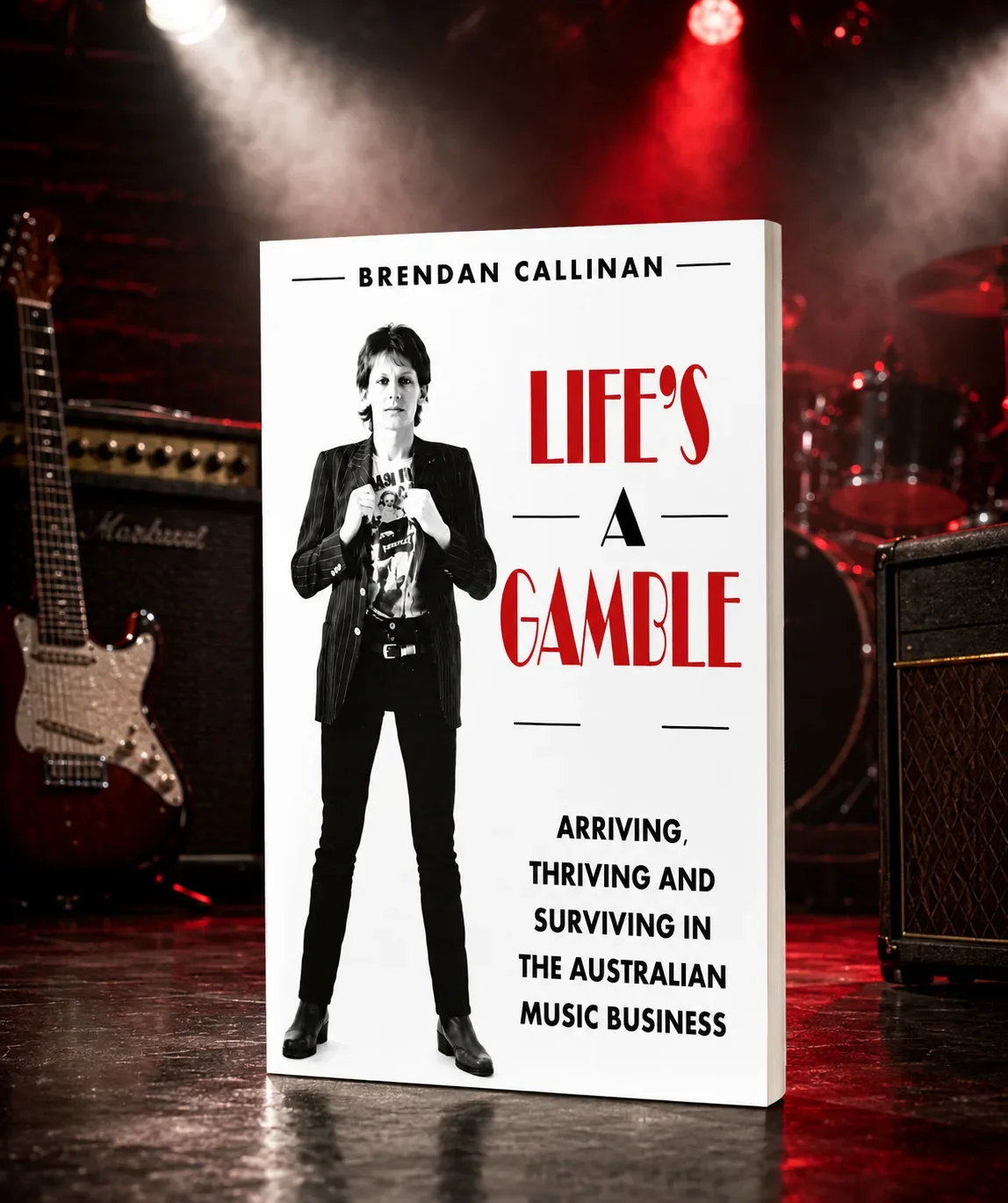
Read THE Full Story
in ‘Life’s A Gamble’
From sold-out stages to life beyond the spotlight, former Radiators keyboardist Brendan Callinan shares the remarkable story behind the music.
Life's a Gamble is an honest, entertaining memoir of resilience, reinvention and surviving the Australian music industry.
